




Yates Nature's Way Fungus Spray
Protects against a very wide range of fungal and bacterial diseases. Formulated from copper and sulfur (naturally occurring compounds).
Create a Yates account today!
Sign up to join the Yates Garden Club for monthly e-mails packed with seasonal inspiration, tips for success & exclusive promotions.
Plus if you’re a Garden Club member you can take part in the Yates Growing Community - a blog to share successes, get advice & win prizes in fun challenges along the way!

Enter the email address associated with your account, and we'll email you a new password.

Pseudomonas syringae pv. passiflorae,
Alternaria passiflorae,
Septoria passifloricola
Fruit and leaf spots on passionfruit can be caused by several bacterial or fungal diseases, that display similar symptoms. The usual culprits are grease spot, brown spot and septoria leaf spot.
Grease Spot (Pseudomonas syringae pv. passiflorae) is one of the most destructive pathogens of passionfruit in NZ. Grease spot is a bacterial disease, closely related to stonefruit blast. Grease spot severely reduces fruit yield, defoliates vines and can kill the plant if left untreated. It attacks leaves, stems and fruit, completely ruining infected fruit. The pathogen is most active during cool, wet weather.
Symptoms include uneven green or brown lesions on leaves, often surrounded by a yellowish ring or halo, usually leading to premature leaf drop. Shallow sunken areas of infection may appear on stems, which can encircle them and kill off the growth above the canker site.
On fruit, small, greasy-looking round spots are the first symptom to show up; these spots become sunken and turn brown, before expanding into wider soggy patches. Infected fruit often drops off early, or rots on the vine.
To prevent control grease spot (and other bacterial spots), apply Yates Nature's Way Fungus Spray at 10-14 day intervals.

Brown Spot (Alternaria passiflorae)
Brown Spot (Alternaria passiflorae) is a serious fungal disease that infects passionfruit leaves, stems and fruit. The spores are spread by wind-blown rain, mainly in spring and early summer, during warm, wet weather. The first signs are when small brown spots break out on the leaves. These spots develop a lighter-coloured, dried-out centre before becoming larger, forming irregular, angular shapes. Infected leaves often drop off prematurely, leaving the vine defoliated.
On young stems, sunken, wet-looking spots can appear; on older stems elongated split cankers can develop, which can expand to ring-bark the stem and stop growth dead.
On fruit, dark green pinprick-sized spots expand into sunken-looking circular lesions, with brownish centres. The sunken areas penetrate into the flesh of the fruit. These spots expand to cover the fruit with ulcerated, wrinkled areas, leading to decayed, inedible fruit that often drops off early.
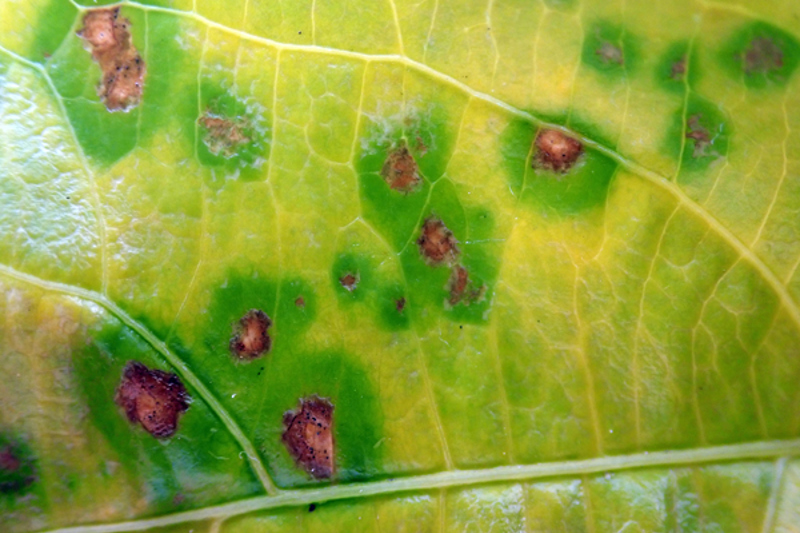
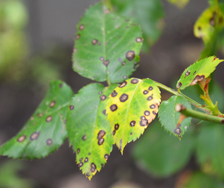
Septoria leaf spot lesions on a passionfruit leaf, showing the fungal fruiting bodies
Image courtesy of Peter de Lange
Septoria Leaf Spot (Septoria passifloricola), aka septoria blotch, is a less destructive fungal disease, although it does still damage fruit. Symptoms begin with small, light brown spots stippling the leaves, stems and fruit. Spots can also be surrounded with brown rings (halos) of dead tissue. Tiny black dots (they’re 'pycnidia', or fungal fruiting bodies, that produce spores) may be visible on the spots.
On fruits, Septoria spots develop into larger patches, eventually covering most of the surface area. Symptoms on fruits can look very similar to brown spot, but Septoria spots aren’t as sunken-looking or wrinkly as Alternaria spots. Although affected passionfruit pulp remains edible, it may ripen unevenly.


Share
Share this article on social media