








Yates Account
Join now
Create a Yates account today!
Sign up to join the Yates Garden Club for monthly e-mails packed with seasonal inspiration, tips for success & exclusive promotions.
Plus if you’re a Garden Club member you can take part in the Yates Growing Community - a blog to share successes, get advice & win prizes in fun challenges along the way!

Forgot password
Enter the email address associated with your account, and we'll email you a new password.

Succulents have the ability to store moisture in their stems or leaves. This clever survival mechanism ensures that they can get through the dry periods that will inevitably occur during the summer months.
Succulents are best grown in free-draining soil or potting mix in an open, sunny situation. If there is any doubt about drainage, build a raised planting area above the existing soil level or plant on top of mounds. Succulent plants like to be watered fairly regularly during the warm months of the year but kept much drier in winter. Potted succulents should be allowed to dry out between waterings.
Some succulent plants suffer during winter and are still looking a bit weather beaten at this time of year. Hence, it’s a good time to tidy them up, remove any dead sections, split crowded clumps and fertilise the plants with a slow release food like Yates Dynamic Lifter Organic Plant Food.
Most succulents grow easily from pieces, either from leaf or stem cuttings. Allow the cutting to dry for a few days, then pot into a loose sandy mix, like Yates Thrive Cacti & Succulent Potting Mix. Keep in light shade for a few months before checking to see if roots have developed.
Succulents come in many forms and in vast numbers. For an extensive overview, it’s best to consult one of the specialist books.
Here’s a list of some of the most attractive and easy to grow:

This group forms flat, saucer-shaped rosettes of shiny foliage. Aeonium arboreum can grow to a branched shrub up to 2 m high. A popular variety is ‘Schwarzkopf’, which has dark mahogany to burgundy foliage.

Agaves make great feature plants with their stiff leaves forming large rosettes that may be up to 1 m across. Many have spiky margins but the popular Agave attenuata, with its smooth grey-green leaves, is widely used in modern, warm climate landscapes.

This group of neat, rosette-forming plants looks especially attractive in pots or hanging baskets. The overlapping leaves may be green, blue to grey, or silver, many with pink flushes. Flowers are held on tall stems high above the foliage and are bell-shaped, mostly red, yellow or orange. Echeverias multiply rapidly and grow easily from pieces.

Jade plant can be found with plain green or variegated leaves. It has thick brown stems and small, round, succulent leaves. It may be grown in a container or in the garden. It adapts well to tough, dry conditions but needs more watering in warm weather. It’s sometimes called the money plant because, if sited near the front door, it’s said to enhance the inhabitants’ wealth.

Foliage of this succulent is the most distinctive shade of frosted blue. It makes a spreading ground cover, its foliage being a great foil for other green-leafed plants. In summer it bears small cream flowers but these are probably best cut off.
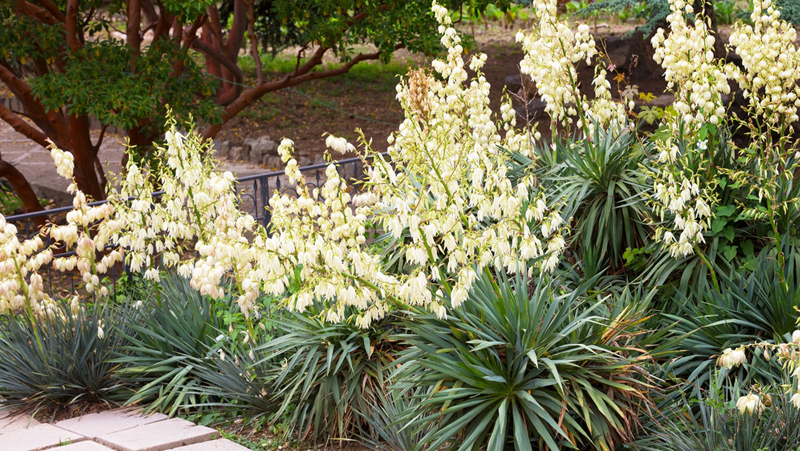
Spineless Yucca (Yucca elephantipes)
In both its plain and variegated forms, yucca has become popular for its architectural shape and its versatility – it can be used both indoors and out.


Yates Thrive Cacti & Succulent Potting Mix
Specifically formulated for the successful growing of cacti and succulents, both indoors in pots and outdoors in the garden bed or pots.
System.NullReferenceException: Object reference not set to an instance of an object.
   at Umbraco.Cms.Core.Models.PublishedContent.PublishedContentType..ctor(IContentTypeComposition contentType, IPublishedContentTypeFactory factory)
   at Our.Umbraco.DocTypeGridEditor.Helpers.DocTypeGridEditorHelper.<>c__DisplayClass15_0.<GetContentTypesByAlias>b__0() in /src/build/Our.Umbraco.DocTypeGridEditor/Helpers/DocTypeGridEditorHelper.cs:line 194
   at Umbraco.Cms.Core.Cache.SafeLazy.<>c__DisplayClass1_0.<GetSafeLazy>b__0()
--- End of stack trace from previous location ---
   at Umbraco.Cms.Core.Cache.ObjectCacheAppCache.Get(String key, Func`1 factory, Nullable`1 timeout, Boolean isSliding, String[] dependentFiles)
   at Umbraco.Cms.Core.Cache.DeepCloneAppCache.Get(String key, Func`1 factory)
   at Our.Umbraco.DocTypeGridEditor.Helpers.DocTypeGridEditorHelper.ConvertValue(String id, String contentTypeAlias, String dataJson) in /src/build/Our.Umbraco.DocTypeGridEditor/Helpers/DocTypeGridEditorHelper.cs:line 91
   at Our.Umbraco.DocTypeGridEditor.Helpers.DocTypeGridEditorHelper.RenderDocTypeGridEditorItem(IViewComponentHelper helper, IHtmlHelper htmlHelper, Object model) in /src/build/Our.Umbraco.DocTypeGridEditor/Helpers/DocTypeGridEditorHelper.cs:line 221
   at AspNetCoreGeneratedDocument.App_Plugins_DocTypeGridEditor_Render_DocTypeGridEditor.ExecuteAsync()
   at Microsoft.AspNetCore.Mvc.Razor.RazorView.RenderPageCoreAsync(IRazorPage page, ViewContext context)
   at Microsoft.AspNetCore.Mvc.Razor.RazorView.RenderPageAsync(IRazorPage page, ViewContext context, Boolean invokeViewStarts)
   at Microsoft.AspNetCore.Mvc.Razor.RazorView.RenderAsync(ViewContext context)
   at Microsoft.AspNetCore.Mvc.ViewFeatures.HtmlHelper.RenderPartialCoreAsync(String partialViewName, Object model, ViewDataDictionary viewData, TextWriter writer)
   at Microsoft.AspNetCore.Mvc.ViewFeatures.HtmlHelper.PartialAsync(String partialViewName, Object model, ViewDataDictionary viewData)
   at AspNetCoreGeneratedDocument.Views_Partials_grid_editors_base.ExecuteAsync() in /src/build/DuluxGroup.CMSWeb/Views/Partials/grid/editors/base.cshtml:line 18
More project guides & articles

Soil Types
Not all soils are created equal! Find out about the commonly encountered soil types; plus what you can do to improve your soil quality.

All About Citrus - How to Choose the Best Variety
Our guide to citrus types, with pros & cons of each. Here's how to make an informed purchase when choosing a citrus to grow at your place.

Everything You Need to Know About Lemon Trees
Our guide to lemon varieties, for NZ gardens. Find out which type will suit you best, plus how to feed and protect it, to keep it happily producing multitudes of lemons.

The Secret's in the Soil
If you’re looking for the secret ingredient for a beautiful healthy garden, then just look down! That’s right, the secret’s in the soil.
Share
Share this article on social media